

Biofuels Market Poised to Reach USD 476.12 Billion by 2035, Growing at 14.0% CAGR
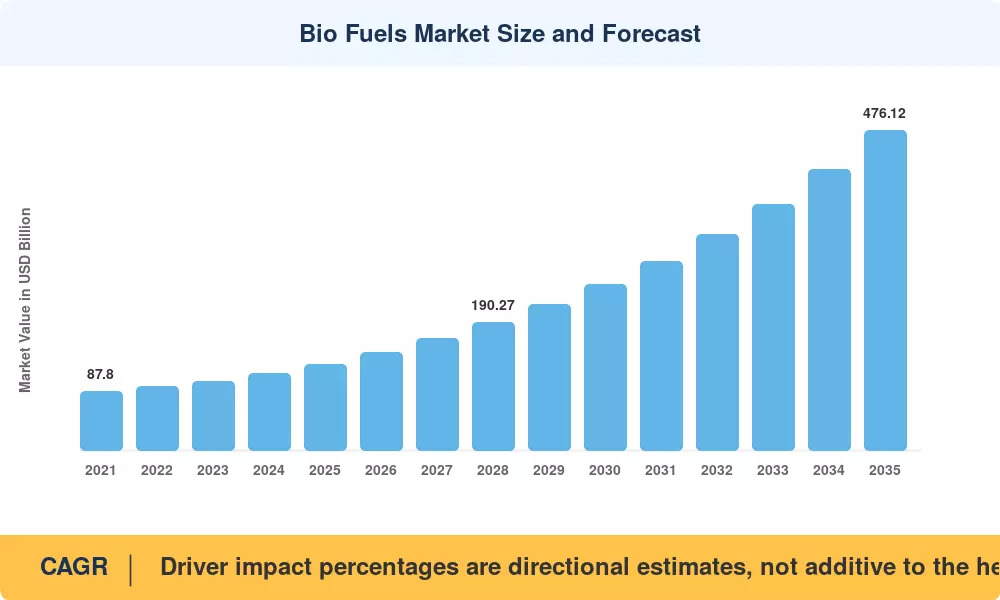
Biofuels Market
As Per the MRFR Analysis, Biofuels Market is forecast to climb to USD 476.12 Billion by 2035.
Biofuels Market is forecast to climb to USD 476.12 Billion by 2035, registering a compound annual growth rate of 14.0% across the forecast 2026 to 2035.”
NEW YORK, NY, UNITED STATES, August 24, 2026 /EINPresswire.com/ -- As Per the MRFR Analysis, Biofuels Market is forecast to climb to USD 476.12 Billion by 2035, registering a compound annual growth rate of 14.0% across the forecast 2026 to 2035, driven by Advancements in second-generation biofuels .— Prashant Hake
Market Overview
The Biofuels Market Size encompasses renewable fuels derived from organic materials such as plant biomass, agricultural residues, animal fats, and municipal waste. These fuels serve as sustainable alternatives to conventional fossil fuels, playing a pivotal role in reducing greenhouse gas emissions and enhancing energy security. Biofuels are broadly categorized into bioethanol, biodiesel, renewable diesel, and sustainable aviation fuels, each offering distinct applications across transportation, power generation, and industrial sectors .
Several key drivers are propelling the robust growth of the Biofuels Market. Chief among these is the global push toward decarbonization, with governments worldwide implementing stringent environmental regulations and ambitious renewable energy targets. The European Union's Renewable Energy Directive III mandates a 14% renewable energy share in transport by 2030, while the U.S. Renewable Fuel Standard continues to drive advanced biofuel adoption . Additionally, volatile crude oil prices and growing energy security concerns are accelerating the shift toward domestically produced renewable fuels .
Technological developments are reshaping the industry landscape. Advancements in enzymatic hydrolysis, thermochemical conversion, and catalytic upgrading have significantly improved biofuel yields while reducing production costs. The emergence of cellulosic ethanol and algae-based biofuels is addressing the traditional food-versus-fuel debate, unlocking new feedstock opportunities from non-food biomass . Biorefineries are increasingly integrating digitalization, employing artificial intelligence and predictive analytics to optimize production processes and enhance operational efficiency.
Policy and regulatory frameworks continue to exert significant influence on market dynamics. Over 70 countries now implement biofuel blending mandates, creating stable demand for renewable fuels. Brazil's RenovaBio program incentivizes low-carbon fuel production through carbon credit mechanisms, while India's E20 ethanol blending target underscores the growing commitment to biofuel adoption in emerging economies .
The demand outlook remains exceptionally positive, with transportation fuels accounting for the majority of biofuel consumption. The aviation sector, in particular, is emerging as a high-growth area, with Sustainable Aviation Fuel (SAF) playing a critical role in achieving net-zero emissions by 2050. The International Energy Agency projects that sustainable fuel demand could more than triple over the next two decades, with road transport driving growth through 2035, followed by increasing adoption in aviation and maritime sectors .
Get Free Sample Report for Detailed Market Insights:
https://www.marketresearchfuture.com/sample_request/2933
Market Segmentation
By Type
The Biofuels Market is segmented into solid, liquid, and gaseous biofuels. Solid biofuels, including wood pellets, chips, and agricultural residues, currently dominate the market, accounting for approximately two-thirds of modern bioenergy use globally. These fuels are widely employed for heating and power generation, particularly in Europe where biomass has played a key role in transitioning away from coal .
Liquid biofuels represent the fastest-growing segment, including ethanol, biodiesel, renewable diesel, and bio-jet fuel. Global liquid biofuel production reached 170 billion liters in 2022, meeting about 3.5% of transport energy requirements. Ethanol constitutes the largest share, while biodiesel and renewable diesel are experiencing rapid growth due to their compatibility with existing vehicle fleets and fueling infrastructure .
By Category
The market is categorized into first-generation, second-generation, and advanced biofuels. First-generation biofuels, derived from food-based feedstocks such as corn, sugarcane, and vegetable oils, currently dominate with nearly 90% market share. Their established production technologies and strong policy support, including blending mandates like India's E20 program and Brazil's biodiesel targets, sustain their dominance .
Second-generation biofuels, produced from non-food biomass including agricultural residues, forestry waste, and municipal solid waste, are gaining significant momentum. Production is projected to reach 30 million metric tons by 2030, driven by growing policy support and technological advancements that enhance commercial viability. These advanced fuels address critical sustainability concerns associated with first-generation biofuels, offering substantial reductions in lifecycle carbon emissions while avoiding competition with food production .
By Application
Transportation remains the dominant application segment, encompassing road transport, aviation, and marine shipping. Road transport leads consumption, with ethanol and biodiesel blended into gasoline and diesel pools worldwide. Sustainable Aviation Fuel (SAF) is emerging as a high-potential segment, driven by aviation industry commitments to decarbonize. Power generation and industrial heating applications also contribute significant demand, particularly for solid biofuels and biogas.
You can buy this market report at:
https://www.marketresearchfuture.com/checkout?currency=one_user-USD&report_id=2933
Regional Analysis
North America
North America maintains a dominant position in the global Biofuels Market, driven by robust government mandates, advanced production technologies, and abundant feedstock availability. The United States remains the world's largest bioethanol producer, leveraging its extensive corn production base. The Renewable Fuel Standard provides stable demand across the renewable fuel portfolio, while Canada's Clean Fuel Regulations further reinforce market growth. Strategic investments in second-generation biorefineries and sustainable aviation fuel projects continue to strengthen the region's market leadership .
Europe
Europe accounts for approximately 28% of the global biofuels market, characterized by stringent environmental policies and aggressive renewable energy targets. The region leads in biodiesel production from rapeseed and is increasingly focusing on waste-derived advanced biofuels. Germany, France, and Sweden are at the forefront of implementing robust biofuel mandates. The revised Renewable Energy Directive mandates a 14% renewable target for transport by 2030, driving substantial investments in advanced biofuel production capacity .
Asia-Pacific
Asia-Pacific represents the fastest-growing regional market, projected to exhibit a remarkable 15% CAGR through 2034. Rapid industrialization, escalating energy demand, and favorable policy environments are fueling market expansion. China is strategically investing in biogas infrastructure and cellulosic ethanol, while India's E20 ethanol blending target creates significant demand. Southeast Asian nations are expanding biodiesel production based on palm oil feedstocks, and Japan is pioneering biohydrogen research for industrial decarbonization. The region's vast agricultural resources and growing commitment to circular economy principles position it as a pivotal growth engine .
Rest of the World
Latin America, led by Brazil, is a powerhouse in sugarcane-based ethanol production, with the country's RenovaBio program creating a sophisticated carbon credit market. Argentina maintains significant biodiesel production capacity from soybeans. The Middle East and Africa represent emerging markets, with several Gulf nations exploring biofuel opportunities to diversify their energy mix and reduce dependence on fossil fuel exports .
Competitive Landscape / Key Players
The Biofuels Market features a competitive landscape comprising multinational energy conglomerates, specialized biorefinery operators, and innovative technology developers. Leading players are increasingly differentiating through technology integration, strategic partnerships, and vertical integration to secure feedstock supplies .
Key companies include Archer Daniels Midland Company (ADM), POET LLC, Valero Energy Corporation, Green Plains Inc., Neste, and Cepsa. Major refiners are retrofitting existing assets to process renewable feedstocks, demonstrating a trend toward dual-feedstock flexibility that enhances operational resilience. Pure-play biorefinery operators are expanding capacity through joint ventures and greenfield projects, leveraging diversified feedstock pipelines covering traditional grains, waste oils, and next-generation biomass .
Strategic developments in the industry include mergers and acquisitions as players pursue economies of scale and expanded geographic reach. Technology alliances between feedstock suppliers, transportation companies, and biotechnology firms are increasingly common, reflecting a holistic approach to value chain integration. Digitalization, including advanced data analytics and digital twin applications, is becoming a competitive differentiator, enabling optimized process parameters and reduced downtime .
Latest Industry News & Developments
Recent industry developments underscore the sector's dynamic evolution and growing investment momentum. Investment in biorefineries processing agricultural residues and organic waste has surged by 40% since 2020, signaling strong industry commitment to second-generation biofuel capacity expansion . Major energy companies continue to announce biorefinery conversion projects, with Phillips 66 investing in its Rodeo refinery in California specifically for processing bio-based feedstocks . Additionally, sustainable aviation fuel projects are receiving significant funding, with airlines and fuel producers collaborating to scale SAF production to meet ambitious decarbonization targets . These developments highlight the industry's strategic pivot toward advanced, low-carbon fuel solutions.
Market Challenges & Opportunities
Despite strong growth prospects, the Biofuels Market faces notable challenges. Feedstock availability and supply chain constraints represent key restraints, with demand for vegetable oils, waste oils, and fats projected to increase 56% from 2022 to 2027. The supply of commonly utilized residues and waste oils is approaching maximum capacity in many regions, potentially limiting production scalability . High production costs, particularly for advanced biofuels, continue to impact economic competitiveness relative to fossil fuels . Additionally, concerns regarding land-use change, biodiversity impacts, and food security require careful management to ensure sustainable industry growth.
Emerging opportunities abound, however. The development of third and fourth-generation biofuels from algae and genetically engineered feedstocks offers transformative potential for sustainable fuel production. Sustainable Aviation Fuel represents a particularly compelling growth avenue, with the aviation sector seeking to decarbonize through bio-based alternatives. Increasing policy harmonization across regions and growing consumer preference for eco-friendly products further enhance market potential . Companies investing in modular, scalable production technologies and robust sustainability traceability systems are well-positioned to capture value in this expanding market.
To explore more market insights, visit us at:
https://www.marketresearchfuture.com/reports/bio-fuels-market-2933
Final Market Summary
The Biofuels Market is on a robust growth trajectory, forecast to reach USD 476.12 Billion by 2035, driven by a 14.0% CAGR. This expansion is fundamentally underpinned by unprecedented advancements in second-generation biofuels, stringent global decarbonization policies, and the urgent imperative to transition toward sustainable energy systems. As technological innovations continue to improve production efficiencies and expand feedstock options, the long-term industry potential remains exceptionally strong. The sector is uniquely positioned to address critical challenges across multiple hard-to-abate sectors, including road transport, aviation, and shipping, while contributing to energy security and rural economic development. As regulatory frameworks strengthen and sustainable fuel mandates proliferate, the Biofuels Market is set to play an increasingly central role in the global energy transition.
More Related Reports from MRFR Library:
Photovoltaic Market: https://www.marketresearchfuture.com/reports/photovoltaic-market-1061
Wind Turbine Blade Market: https://www.marketresearchfuture.com/reports/wind-turbine-blade-market-1150
Wind Power Market: https://www.marketresearchfuture.com/reports/wind-power-market-1511
Carbon Capture and Storage Market: https://www.marketresearchfuture.com/reports/carbon-capture-storage-market-1862
Offshore Supply Vessels Market: https://www.marketresearchfuture.com/reports/offshore-supply-vessels-market-2067
Metering Pump Market: https://www.marketresearchfuture.com/reports/metering-pump-market-2913
Biofuels Market: https://www.marketresearchfuture.com/reports/bio-fuels-market-2933
Gas Turbine Market: https://www.marketresearchfuture.com/reports/gas-turbine-market-3265
Energy Storage Market: https://www.marketresearchfuture.com/reports/energy-storage-market-4476
Virtual Power Plant Market: https://www.marketresearchfuture.com/reports/virtual-power-plant-market-5583
Larry Wilson
WantStats Research And Media Pvt. Ltd.
+ +1 855-661-4441
email us here
Visit us on social media:
LinkedIn
Facebook
YouTube
X
Legal Disclaimer:
EIN Presswire provides this news content "as is" without warranty of any kind. We do not accept any responsibility or liability for the accuracy, content, images, videos, licenses, completeness, legality, or reliability of the information contained in this article. If you have any complaints or copyright issues related to this article, kindly contact the author above.
