

Tracing the ripple effects of the Middle East war on euro area consumption
Prepared by Neus Dausà i Noguera, Maria Dimou and Omiros Kouvavas
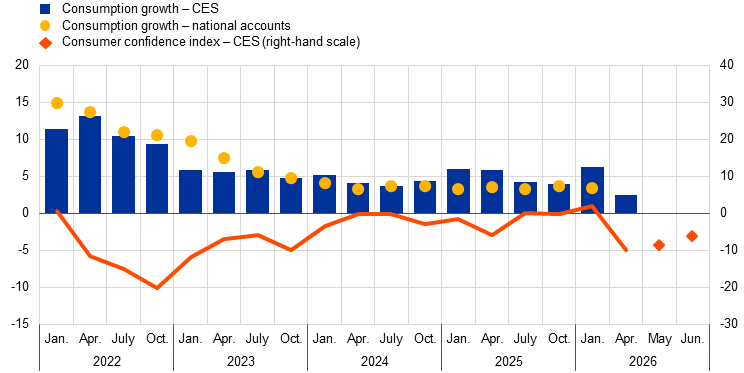
Euro area consumer confidence deteriorated markedly in the months following the outbreak of the war in the Middle East. The consumer confidence index (CCI), which is based on responses to the ECB Consumer Expectations Survey (CES), fell by around 12 index points cumulatively between February and April. This decline was comparable in magnitude to the 15 index point decrease recorded in the first two months following Russia’s invasion of Ukraine. Although the CCI partially rebounded in May and June, increasing by 3.5 index points, a key question that remains is whether the sharp initial fall reflected changes in consumer behaviour or was primarily a sentiment shock, with more limited implications for actual consumption if the shock were to prove temporary.[1] This box addresses this question by linking individual consumer confidence to self-reported nominal consumption across 16 expenditure categories. The analysis distinguishes between necessities and discretionary spending.[2]
In parallel with this deterioration in consumer confidence, consumption momentum also weakened, as reported by euro area consumers in the April wave of the CES. Chart A shows the average year-on-year growth rate of nominal consumption. The evidence suggests that consumption momentum softened materially. After hovering around 3-4% on average from mid-2024, nominal consumption growth declined to around 2.5% year on year in April 2026.
Chart A
Nominal consumption growth and consumer confidence
(left-hand scale: year-on-year growth rates; right-hand scale: index points)
Sources: CES, Eurostat and ECB staff calculations.
Notes: The blue bars show total consumption growth based on the CES, while the yellow dots show the corresponding year-on-year growth rate of nominal consumption from the national accounts. CES consumption growth is calculated as the weighted mean of individual consumption growth rates, using survey, income and consumption weights, and is based on observations within ±1 standard deviation of the underlying distribution. Observations up to and including April 2026 are quarterly; those for May and June 2026 are monthly. The latest observations are for April 2026 for CES consumption growth, the first quarter of 2026 for national accounts consumption growth and June 2026 for the CES consumer confidence index.
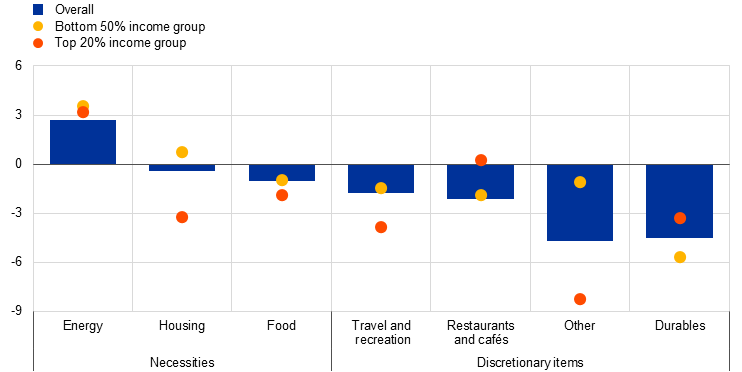
This slowdown was driven mainly by weaker growth in discretionary spending categories. Chart B shows the change in year-on-year consumption growth across expenditure categories relative to the average over the 12 months preceding the start of the war. The adjustment was not uniform. Discretionary categories – expenditure on which is easier to postpone – declined the most, while nominal spending on energy increased, mainly reflecting higher transport costs, including fuel. Other necessities, notably housing and food, proved resilient.[3] Furthermore, higher-income households seem to have adjusted more than lower-income households. This is consistent with higher-income households having greater scope to adjust their spending, particularly by postponing discretionary purchases such as luxury clothing and footwear or sports equipment, reducing travel or cutting back on non-essential services such as elective wellness treatments and similar services. By contrast, lower-income households mainly adjusted spending on durable goods and restaurants and cafés. This likely reflects lower-income households’ more limited scope for adjustment, as a larger share of their budget is absorbed by necessities. Overall, the weakening in nominal consumption appears to have been driven largely by households that are not budget constrained but are choosing to delay spending in response to heightened uncertainty.[4] Although higher prices associated with the war in the Middle East may also have played a role, the analysis below suggests the presence of a sentiment-driven channel that persists even after controlling for realised income.
Chart B
Deviations in year-on-year consumption growth across expenditure categories and income groups
(percentage point deviations from the previous 12-month average)
Sources: CES and ECB staff calculations.
Notes: The blue bars show the percentage point deviation in the year-on-year growth rate of nominal consumption in April 2026 from the average recorded over the 12 months preceding the start of the war. The dots show the corresponding percentage point deviations for the bottom 50% and top 20% income groups. Income groups are calculated at the (monthly) country-by-survey wave level. For definitions of expenditure categories, see footnote 2.
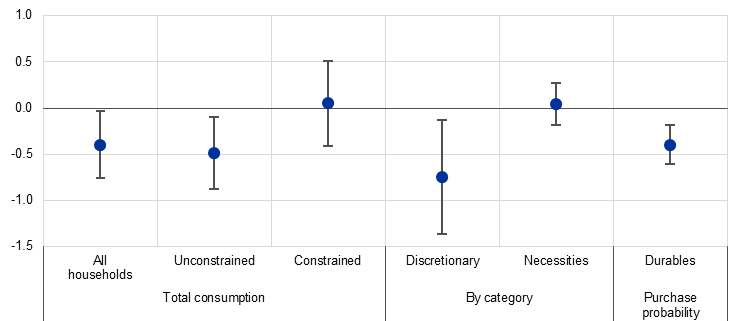
The association between the recent confidence shock and consumption was stronger than historical patterns would suggest. Using microdata from the CES, it is possible to estimate the relationship between changes in individual consumer confidence and consumption growth.[5] Chart C shows that households that suffered a larger drop in confidence also recorded a larger reduction in consumption. A 10 point fall in confidence on a year-on-year basis was associated, on average, with a reduction of around 0.4 percentage points in year-on-year individual nominal consumption growth in April 2026. This effect is substantially larger than the estimated relationship over the full sample period – which points to a reduction of around 0.2 percentage points – and is comparable in magnitude to that observed after the start of Russia’s war in Ukraine in April 2022. This suggests that the confidence channel is particularly strong in the case of large shocks that are widely perceived as such by consumers. In normal times, changes in confidence may partly reflect noise or idiosyncratic household perceptions. In the context of the war in the Middle East, however, the shock is common, salient and directly linked to risks to energy prices, inflation and real incomes. Hence, the fall in confidence appears to have a stronger and more immediate impact on consumption. The effect is driven mainly by unconstrained households and by discretionary consumption. This reinforces the view that the slowdown is not the result of binding income constraints but rather of households postponing purchases when they have the scope to adjust the timing of their spending.[6]
Chart C
Consumer confidence index and consumption growth following the start of the war in the Middle East
(regression coefficients)
Sources: CES and ECB staff calculations.
Notes: The chart shows coefficients from cross-sectional regressions where the individual year-on-year growth rates of each consumption variable in April 2026 are regressed on year-on-year changes in consumer confidence, with time, country, realised income, education, gender and age-group fixed effects. Coefficients are reported for a 10 point decrease in consumer confidence. The final column shows the marginal effect from a probit model in which a dummy variable indicating the probability of purchase of a durable good in the previous month is regressed using the same variables. Whiskers represent 90% confidence intervals.
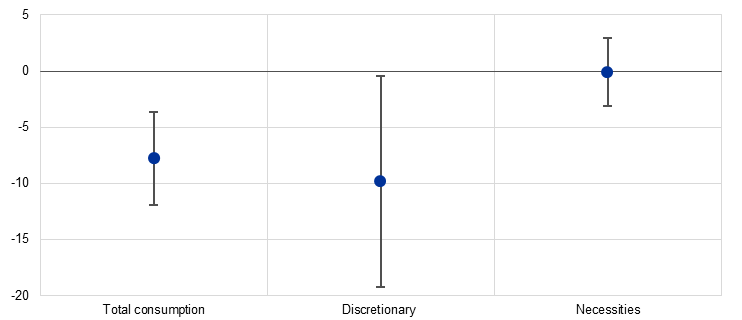
Perceived real income losses could pose an additional downside risk. In April CES respondents were also asked about their expectations concerning real income developments under a scenario in which the war in the Middle East leads to persistent inflation.[7] Around 40% of respondents reported that they did not expect any catch-up. This is relevant for consumption dynamics, as the permanent income hypothesis predicts that households should adjust consumption more strongly when they perceive income losses as persistent rather than temporary. Past evidence is consistent with this mechanism (Baumann et al., 2025a). Chart D shows that households expecting permanent real income losses already displayed stronger signs of spending adjustment. This points to an important risk: if households were to perceive the real income losses stemming from the conflict as persistent and associate them with lower real purchasing power, the initial sentiment-driven slowdown could become more entrenched.
Chart D
Expected permanent real income losses and consumption growth
(percentage point changes in year-on-year growth rates)
Sources: CES and ECB staff calculations.
Notes: The chart shows coefficients from difference-in-difference regressions in which individual year-on-year consumption growth rates in April 2026 are regressed on a dummy variable equal to one if the respondent indicated that they did not expect a subsequent catch-up in real income. Regressions include time, country and individual-level controls. Whiskers represent 90% confidence intervals.
Overall, the close relationship between consumer confidence and consumption growth suggests that there could be renewed challenges to consumption if the recent recovery in confidence were to prove temporary. The confidence shock in the context of the war in the Middle East appears to have exerted a dampening effect on demand, which could weigh on underlying consumption momentum. Additional downside risks could materialise if households were to perceive the real income losses stemming from the conflict as persistent. However, because much of the adjustment in consumption appears to have been sentiment-driven rather than income-driven, it could prove reversible if tensions were to ease and the recovery in confidence were sustained. In this case, some of the discretionary spending that has been postponed could return. At the time of writing, incoming data point to a partial improvement in confidence among euro area consumers.[8] Nonetheless, confidence remains significantly below its pre-war level and the economic outlook is surrounded by considerable uncertainty.
References
Andreolli, M., Rickard, N. and Surico, P. (2024), “Non-Essential Business Cycles”, Discussion Paper, No 19773, CEPR, 15 December.
Andreolli, M., Rickard, N., Surico, P. and Vergeat, C. (2025), “Discretionary Spending is the Cycle, and Why it Matters for Monetary Policy”, Adapting to change: macroeconomic shifts and policy responses – ECB Forum on Central Banking 30 June-2 July 2025, ECB, Frankfurt am Main.
Baumann, A., Caprari, L., Kocharkov, G. and Kouvavas, O. (2025a), “Are real incomes increasing or not? Household perceptions and their role for consumption”, Economic Bulletin, Issue 5, ECB.
Baumann, A., Caprari, L., Dossche, M., Kocharkov, G. and Kouvavas, O. (2025b), “Consumer confidence and household consumption decisions”, Economic Bulletin, Issue 5, ECB.
Bobasu, A., (2026), “Does uncertainty affect household spending on goods and services differently?” in Andersson, M., Bobasu, A., Saiz, L. and Scrofani, S., “The cost of not knowing: how uncertainty weighs on the euro area economy”, Economic Bulletin, Issue 5, ECB.
Bobasu, A. and Dobrew, M. (2026), “Feeling the heat unevenly: energy prices and household consumption”, Economic Bulletin, Issue 5, ECB.
Carroll, C.D., Fuhrer, J.C. and Wilcox, D.W. (1994), “Does Consumer Sentiment Forecast Household Spending? If So, Why?”, The American Economic Review, Vol. 84, No 5, pp. 1397-1408.
Ludvigson, S.C. (2004), “Consumer Confidence and Consumer Spending”, Journal of Economic Perspectives, Vol. 18, No 2, pp. 29-50.
Legal Disclaimer:
EIN Presswire provides this news content "as is" without warranty of any kind. We do not accept any responsibility or liability for the accuracy, content, images, videos, licenses, completeness, legality, or reliability of the information contained in this article. If you have any complaints or copyright issues related to this article, kindly contact the author above.
