

Rising Demand for Fuel Efficiency and Vehicle Safety Drives Automotive Powertrain Sensors Market to US$ 37.7 Bn by 2033
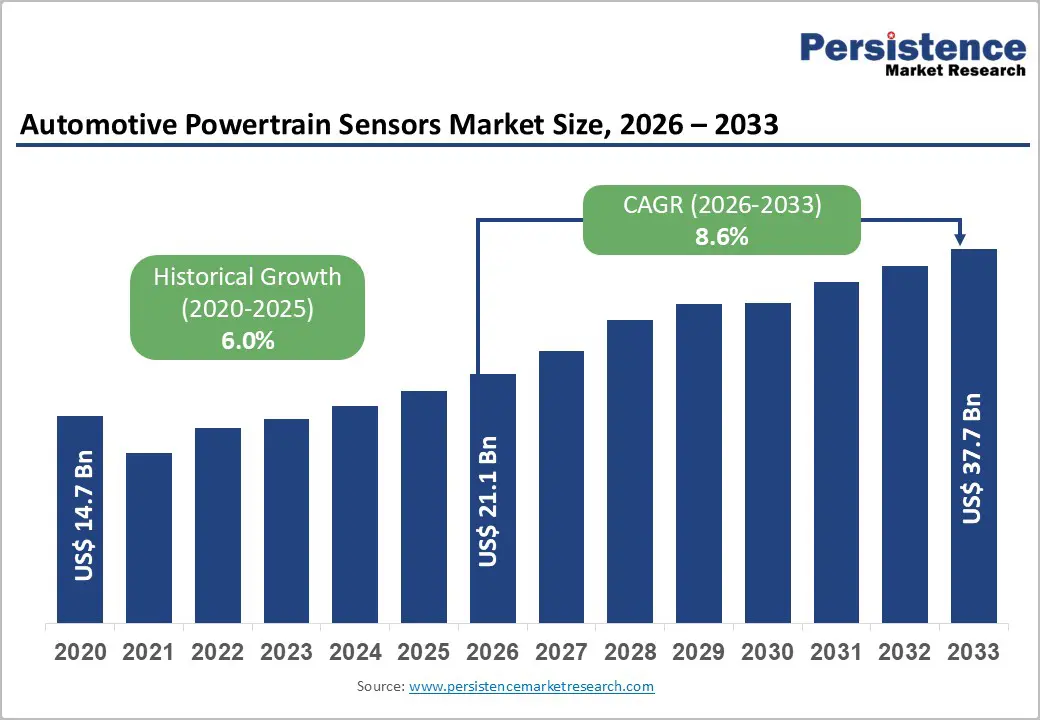
Automotive Powertrain Sensors Market Size
Advancements in hybrid and electric vehicle technology are fueling robust growth and higher adoption of automotive powertrain sensors globally.
BRENTFORD, LONDON, UNITED KINGDOM, January 28, 2026 /EINPresswire.com/ -- The global automotive powertrain sensors market has emerged as a crucial segment of the automotive industry, driven by increasing demand for fuel efficiency, emission reduction, and advanced vehicle performance monitoring. Powertrain sensors, which include components such as pressure sensors, temperature sensors, and position sensors, play an essential role in ensuring optimal engine performance and compliance with stringent emission regulations. With the rise of connected vehicles and growing adoption of advanced driver-assistance systems (ADAS), the integration of powertrain sensors into vehicles is becoming increasingly important. Manufacturers are investing in research and development to enhance sensor precision, durability, and integration with vehicle electronics, which further propels market growth.
According to Persistence Market Research, the global automotive powertrain sensors market is projected to reach a valuation of US$ 21.1 billion by 2026, expanding further to US$ 37.7 billion by 2033. This growth represents a CAGR of 8.6% between 2026 and 2033, signaling a robust and sustained market expansion. The growth is primarily driven by the increasing penetration of electric and hybrid vehicles, rising consumer demand for high-performance vehicles, and government initiatives promoting fuel-efficient automotive technologies. The leading product segment within this market includes engine control sensors, owing to their critical role in monitoring and optimizing engine functions. Geographically, Asia-Pacific dominates the market, primarily due to large automotive manufacturing hubs in countries like China, India, and Japan, which are witnessing rapid technological adoption and regulatory support for eco-friendly vehicles.
Get Your FREE Sample Report Instantly Click Now: https://www.persistencemarketresearch.com/samples/34908
The key players studied in the report include:
• Continental AG
• DENSO CORPORATION
• Infineon Technologies AG
• Mitsubishi Electric Mobility Corporation
• NXP Semiconductors
• Renesas Electronics Corporation
• Robert Bosch GmbH
• TE Connectivity
• Texas Instruments Incorporated
• Valeo SA
• Other Market Players
Key Highlights from the Report
➤ The global automotive powertrain sensors market is expected to witness a CAGR of 8.6% between 2026 and 2033.
➤ Engine control sensors hold the largest market share due to their role in emission control and performance optimization.
➤ Pressure sensors and temperature sensors are gaining traction for improved fuel efficiency and emission reduction.
➤ Asia-Pacific is the leading regional market, driven by rapid automotive production and technology adoption.
➤ Growing adoption of hybrid and electric vehicles is fueling demand for advanced powertrain sensors.
➤ Increasing government regulations on vehicle emissions and fuel efficiency standards are key growth enablers.
Market Segmentation
By Sensor Type
• Temperature
• Current
• Position
• Exhaust
• Voltage
• Speed
• Torque
• Pressure
• Others
By Powertrain Subsystem
• Engine
• Drivetrain
• Exhaust
By Vehicle Type
• ICE Vehicles
• Hybrid Vehicles
• Electric Vehicles
By Region
• North America
• Europe
• Asia Pacific
• Latin America
• Middle East & Africa
Customize This Report for Your Exact Requirements: https://www.persistencemarketresearch.com/request-customization/34908
Regional Insights
Asia-Pacific is the largest regional market for automotive powertrain sensors, attributed to the presence of major automotive manufacturing hubs in China, India, and Japan. The region benefits from high vehicle production volumes, government support for emission reduction technologies, and increasing demand for advanced vehicles. Additionally, domestic sensor manufacturers in the region are investing in R&D to cater to growing regional requirements.
North America and Europe are also significant markets, driven by technological advancements, stringent emission regulations, and high adoption of electric and hybrid vehicles. Europe’s market is further supported by strict EU mandates on emission control and energy efficiency standards, while North America benefits from a strong automotive technology ecosystem and early adoption of connected and smart vehicles.
Market Drivers
The automotive powertrain sensors market is primarily fueled by the increasing need for fuel efficiency and emission control in vehicles. Governments worldwide are implementing stringent emission standards, encouraging manufacturers to integrate advanced sensors into vehicle powertrains. Additionally, the rising adoption of hybrid and electric vehicles is driving demand for precision sensors capable of monitoring complex engine and battery systems. Consumer expectations for vehicle performance, safety, and reliability also support the growth of high-performance powertrain sensors.
Another key driver is the continuous advancement in automotive technology. Integration of sensors into engine control units (ECUs) and advanced driver-assistance systems ensures better vehicle diagnostics and maintenance capabilities. The push for connected and autonomous vehicles is further stimulating demand for accurate, reliable, and real-time sensor data, making powertrain sensors an essential component for next-generation automotive technologies.
Market Opportunities
The automotive powertrain sensors market presents several growth opportunities. The rising popularity of electric and hybrid vehicles creates demand for advanced sensor technologies, particularly for battery management, energy efficiency, and emission reduction systems. Manufacturers can capitalize on this shift by developing innovative, high-precision sensors tailored for electrified powertrains.
Additionally, emerging markets in Asia-Pacific and Latin America offer substantial growth potential due to increasing vehicle production and adoption of fuel-efficient technologies. Collaborations between automotive manufacturers and sensor suppliers can also unlock opportunities for product innovation and integrated solutions, driving overall market expansion. The increasing focus on connected vehicles and real-time vehicle monitoring further supports long-term growth prospects for sensor technologies.
Ready to Dive Deep? Buy Full Report Today: https://www.persistencemarketresearch.com/checkout/34908
Recent Developments:
• January 2025: Bosch introduced a next-generation pressure sensor for electric and hybrid vehicles.
• November 2024: Denso expanded its manufacturing facility in Japan to produce advanced temperature and position sensors for automotive applications.
Future Opportunities and Growth Prospects
The future of the automotive powertrain sensors market looks promising, with continued adoption of electric and hybrid vehicles, increasing emission regulations, and technological advancements in connected and autonomous vehicles. Manufacturers investing in high-precision, durable, and cost-effective sensor solutions are well-positioned to capture emerging opportunities. Expansion into emerging markets and partnerships for integrated automotive solutions will further accelerate market growth, paving the way for innovation and sustainability in the automotive powertrain sector.
Explore the Latest Trending Research Reports:
• Commercial Aircraft Landing Gear Market
• Automotive Airbag Inflator Market
Persistence Market Research
Persistence Market Research Pvt Ltd
+1 646-878-6329
email us here
Visit us on social media:
LinkedIn
Instagram
Facebook
YouTube
X
Legal Disclaimer:
EIN Presswire provides this news content "as is" without warranty of any kind. We do not accept any responsibility or liability for the accuracy, content, images, videos, licenses, completeness, legality, or reliability of the information contained in this article. If you have any complaints or copyright issues related to this article, kindly contact the author above.
